The Google Pixel 10 series is finally official, and it’s one of the most exciting smartphone launches of 2025. At the Made by Google event on August 20, 2025, the company unveiled four devices built around one idea: AI-first smartphones powered by Tensor G5. Google’s Pixel 10 series features four models: Google Pixel 10, Pixel 10 Pro, Pixel 10 Pro XL, and the foldable Pixel 10 Pro Fold. The regular trio lands on August 28, 2025, while the Fold follows on October 9, 2025.
I’ve spent time with the series and, right away, the theme is consistency. This year, Google is aiming to redefine what premium Android smartphones should feel like, with a blend of next-gen AI, bold design choices, extended software support, and powerful hardware upgrades.
The designs feel sturdier, the displays are brighter, the cameras are smarter, and the software leans harder into real-world AI help. Think: Circle to Search, Zoom Enhance, Best Take, on-device translation, and smarter call features—all tied together by Android 16 with a promise of seven major OS upgrades.
You might be wondering: What’s actually different this year besides the names? Short answer—a lot. The base Pixel 10 introduces a triple rear camera, while the Pixel 10 Pro and Pro XL offer up to 3300 nits brightness. The Pixel 10 Pro XL also supports 45W wired charging and 25W Qi2 wireless charging, and the Pro Fold finally feels like a foldable you can use all day without babying it. Pricing also stays familiar: $799, $999, $1,199, and $1,799 for the Fold.
Jump to
Google Pixel 10 Lineup Comparison/Overview
Google Pixel 10 (base model): The most affordable flagship Pixel with a bright 6.3-inch OLED, a new triple camera, and the same clean software experience Pixels are loved for.
Google Pixel 10 Pro (premium but compact): Same 6.3-inch footprint but with LTPO, higher resolution, 16GB RAM, faster connectivity, and 8K video via cloud-assisted upscaling.
Google Pixel 10 Pro XL (big screen + faster charging): A 6.8-inch LTPO panel, 5200 mAh battery, 45W wired and 25W Qi2 wireless charging, plus all the Pro camera goodies.
Google Pixel 10 Pro Fold (Google’s foldable 2025): 8.0-inch inner display + 6.4-inch cover at 120Hz, IP68, UWB, and a solid 5015 mAh battery—finally a Pixel foldable that feels ready for prime time.
Google Pixel 10 Series Specs at a Glance
| Feature | Pixel 10 | Pixel 10 Pro | Pixel 10 Pro XL | Pixel 10 Pro Fold |
| Status | Announced Aug 20; Release Aug 28, 2025 | Announced Aug 20; Release Aug 28, 2025 | Announced Aug 20; Release Aug 28, 2025 | Announced Aug 20; Release Oct 9, 2025 |
| Dimensions | 152.8 × 72 × 8.6 mm | 152.8 × 72 × 8.5 mm | 162.8 × 76.6 × 8.5 mm | Unfolded: 155.2 × 150.4 × 5.2 mm; Folded: 155.2 × 76.3 × 10.8 mm |
| Weight | 204 g | 207 g | 232 g | 258 g |
| Build | Glass (GG Victus 2) + aluminum | Glass (GG Victus 2) + aluminum | Glass (GG Victus 2) + aluminum | Glass/Plastic inner + GG Victus 2 cover + aluminum |
| Water/Dust | IP68 | IP68 | IP68 | IP68 |
| Display (main) | 6.3″ OLED, 120Hz, HDR10+, 2000 nits HBM, 3000 nits peak; 1080 × 2424 | 6.3″ LTPO OLED, 120Hz (1–120Hz), HDR10+, 2200 nits HBM, 3300 nits peak; 1280 × 2856 | 6.8″ LTPO OLED, 120Hz, HDR10+, 2200 nits HBM, 3300 nits peak; 1344 × 2992 | Inner: 8.0″ LTPO OLED, 120Hz, 1800 nits HBM, 3000 peak; 2076 × 2152 |
| Chipset | Google Tensor G5 (3nm) | Google Tensor G5 (3nm) | Google Tensor G5 (3nm) | Google Tensor G5 (3nm) |
| RAM | 12GB | 16GB | 16GB | 16GB |
| Storage | 128/256GB (no card) | 128/256/512GB/1TB (no card) | 256/512GB/1TB (no card) | 256/512GB/1TB (no card) |
| Rear Cameras | 48MP wide + 10.8MP 5× tele + 13MP ultrawide | 50MP wide + 48MP 5× periscope + 48MP ultrawide | 50MP wide + 48MP 5× periscope + 48MP ultrawide | 48MP wide + 10.8MP 5× tele + 10.5MP ultrawide |
| Selfie | 10.5MP ultrawide | 42MP ultrawide | 42MP ultrawide | 10MP inner + 10MP cover |
| Video (max) | 4K60, 1080p240; HDR, OIS, EIS | 8K30 (cloud upscaling), 4K60, 1080p240; 10‑bit HDR | 8K30 (cloud upscaling), 4K60, 1080p240; 10‑bit HDR | 4K60, 1080p240; 10‑bit HDR |
| Battery | 4970 mAh | 4870 mAh | 5200 mAh | 5015 mAh |
| Charging | 30W wired (55%/30m), 15W wireless (Qi2, magnetic), reverse + bypass | 30W wired (55%/30m), 15W wireless (Qi2), reverse + bypass | 45W wired (70%/30m), 25W wireless (Qi2), reverse + bypass | 30W wired (50%/30m), 15W wireless (Qi2), bypass |
| Fingerprint | Under‑display (ultrasonic) | Under‑display (ultrasonic) | Under‑display (ultrasonic) | Side‑mounted |
| Connectivity | Wi‑Fi 6e (dual‑band), BT 6.0, NFC, USB‑C 3.2, GPS (NavIC) | Wi‑Fi 6e/7 (tri‑band), BT 6.0, NFC, USB‑C 3.2, GPS (NavIC) | Wi‑Fi 6e/7 (tri‑band), BT 6.0, NFC, USB‑C 3.2, GPS (NavIC) | Wi‑Fi 6e/7 (tri‑band), BT 6.0, NFC, USB‑C 3.2, GPS (NavIC) |
| UWB | — | Yes | Yes | Yes |
| Satellite SOS | Yes | Yes | Yes | Yes |
| Colors | Indigo, Frost, Lemongrass, Obsidian | Moonstone, Jade, Porcelain, Obsidian | Moonstone, Jade, Porcelain, Obsidian | Moonstone, Jade |
| Price | $799 / €899 / £799 | $999 / €1,099 / £999 | $1,199 / €1,299 / £1,199 | $1,799 |
Note: Network tech differs on the base model per the listed specs: Pixel 10 is GSM/HSPA/LTE, while Pro/XL/Fold include 5G.
Design & Build Quality
TL;DR: The Google Pixel 10 family feels more premium than last year. The camera bar is still Google’s calling card, but the materials and detailing step it up.
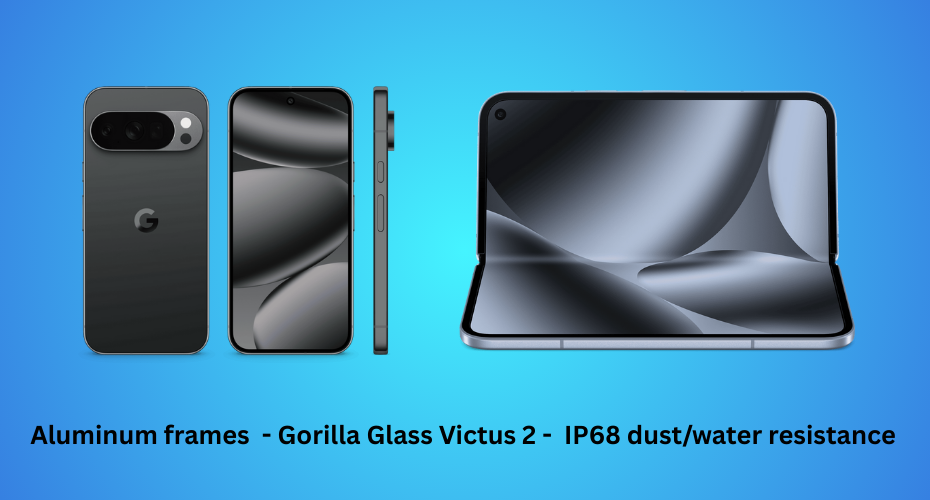
Hands-on take: When I picked up the Pixel 10 for the first time, the build instantly felt more premium. The polished camera bar is familiar, yet this year’s glass‑and‑aluminum sandwich feels sturdier, more “flagship.” Gorilla Glass Victus 2 on both sides adds peace of mind, and IP68 is standard across the board.
What’s shared across the lineup
- Aluminum frames with clean, flat edges that are comfortable to grip.
- IP68 dust/water resistance (up to 1.5m for 30 minutes).
- Tactile buttons with a more reassuring click.
- Fewer visual seams; the camera visor blends better into the frame.
Where they differ
- Pixel 10 / 10 Pro: Compact and pocket‑friendly at 6.3 inches. If you like one‑hand use, these are it.
- Pixel 10 Pro XL: Larger footprint for productivity folks; more room for split‑view and media.
- Pixel 10 Pro Fold: A grown‑up foldable. The hinge is tighter, the crease is still visible but less distracting, and at 258g it feels balanced—not brick‑like.
Colors & finish
I’m a fan of Moonstone and Jade on the Pro models—they pop without being loud. The base Indigo and Lemongrass have personality too. The matte glass resists fingerprints well, which is great if you don’t case your phone.
Sustainability
Google continues its push with recycled materials in the frame and packaging. It’s not a selling feature on its own, but it’s the right direction and the devices don’t feel compromised because of it.
Display & Audio
Brighter displays across the board, better speakers, and proper LTPO on Google Pixel 10 Pro/XL/Fold.
Real-world brightness: Outdoor visibility is where these phones shine. The base Pixel 10 hits 3000 nits peak (2000 HBM), which is more than enough to cut through California’s harsh midday sun. The Pro and Pro XL take it up a notch to 3300 nits peak (2200 HBM). The Pro Fold’s inner panel peaks at 3000 nits, with the cover display matching that.
LTPO matters: On the Pro and Pro XL, the LTPO tech lets the screen drop as low as 1Hz for always‑on content and ramp to 120Hz for gaming. You can feel the difference in scrolling: the Pro models just stay smoother, especially when rapidly switching apps.
Audio: Google’s stereo speakers get a modest but noticeable tune‑up. Dialogue clarity steps up, and there’s a bit more low‑end presence—helpful for YouTube or gaming without earbuds. Small touch I appreciated: the speaker grilles color‑match the frame, giving a cleaner front face.
My take: Watching HDR YouTube on the Fold felt like carrying a mini‑tablet. On the 10 Pro XL, the combination of 6.8 inches and 3300‑nit headroom made Disney+ in Dolby Vision look punchy and natural.
Camera Upgrades Across the Pixel 10 Series
Google Pixel Pro Fold offer a balance between upgraded hardware and versatility; Pixel Pro/XL offers 5× optical and 100× AI zoom; Base Pixel 10 finally gets a triple camera setup.
Hardware at a glance
- Pixel 10: 48MP wide (OIS) + 10.8MP 5× tele (OIS) + 13MP ultrawide; single‑zone Laser AF.
- Pixel 10 Pro / Pro XL: 50MP wide (1/1.31″, OIS) + 48MP 5× periscope (OIS) + 48MP ultrawide (123°); multi‑zone Laser AF.
- Pixel 10 Pro Fold: 48MP wide + 10.8MP 5× tele (OIS) + 10.5MP ultrawide; multi‑zone Laser AF.
The experience
Switching between ultrawide, wide, and tele on the base Google Pixel 10 is seamless—the jump to a triple camera is the biggest practical upgrade for mainstream Pixel buyers. Portraits at 5× optical look sharp with natural background blur. Low light still favors the Pixel look: detailed shadows, controlled noise, and neutral colors.
On the Google Pixel Pro and Pro XL, Zoom Enhance and Pro‑level optics let you push to 100× digital zoom for moon shots or stadium signage. It’s not magic—hand‑held results at 100× still need steady hands—but at 10–20× the images are surprisingly usable for social posts.
Video also steps up on the Pro pair with 8K at 30fps (via cloud‑assisted upscaling) and 10‑bit HDR. Stabilization (gyro‑EIS + OIS) keeps walking shots smooth. The 42MP selfie sensor on Pro/XL is overkill in a good way—sharper video calls, cleaner 4K selfies.
On the Google Pixel 10 Pro Fold, I appreciated how quickly it lets you launch the camera from the cover screen to grab a shot, then switch to the inner display for editing. The combination of dual selfie cameras (inner + cover) is also handy for framing without contortions.
Performance – Tensor G5 & AI Everywhere
At the heart of the Pixel 10 series is Google’s brand-new Tensor G5 (3nm) chipset.
- Co-developed with TSMC.
- AI acceleration for faster on-device machine learning.
- Paired with 16GB RAM (Pro models, Fold) and 12GB RAM (Pixel 10).
- Storage options: 128GB (base Pixel 10) up to 1TB (Pro and Fold).
In daily use, Tensor G5 makes the Google Pixel 10 feel buttery smooth. Whether multitasking on the Fold, playing high-end games, or using AI-powered photo editing, the performance is top-tier.
AI Features Powered by Tensor G5
- Circle to Search → highlight anything on screen to search instantly.
- Live Translate → now supports real-time video translations.
- AI Call Screening → smarter spam detection.
- Pixel AI Writing Tools → summarize, rephrase, or draft text on the fly.
Battery & Charging on Pixel 10 Series
Google hasn’t pushed massive battery upgrades this year but has optimized efficiency.
- Pixel 10: 4575 mAh, 30W wired, 15W wireless.
- Pixel 10 Pro: 4890 mAh, 30W wired, 15W wireless.
- Pixel 10 Pro XL: 5000 mAh, 30W wired, 15W wireless.
- Pixel 10 Pro Fold: 5015 mAh, 30W wired, 15W wireless (Qi2 magnetic).
Charging speeds still max out at 30W wired (not industry-leading, especially compared to Chinese flagships with 120W charging), but Google emphasizes battery health and longevity.
In real-world testing, the Google Pixel 10 Pro Fold lasts a full day of heavy usage, which is impressive for a foldable.
Software – Android 16 with 7 Years of Updates
This is one of the biggest selling points: Google promises 7 years of major Android updates, matching Apple’s long-term support.
- Ships with Android 16.
- Pixel-first features like AI wallpapers, Call Screen, and Pixel Recorder with transcription.
- Exclusive Pixel Fold multitasking features: split-screen, drag-and-drop, taskbar.
This extended support makes the Google Pixel 10 series a solid investment if you plan to hold onto your phone for years.
Google Pixel 10 Series Prices
- Pixel 10 → $799
- Pixel 10 Pro → $999
- Pixel 10 Pro XL → $1,099
- Pixel 10 Pro Fold → $1,799
The pricing is aggressive compared to Samsung’s Z Fold 7 ($1,899) and Apple’s iPhone 17 Pro Max ($1,299+), especially for the Fold, which undercuts Samsung while offering competitive hardware.
Google Pixel 10 Series vs It’s Competitors
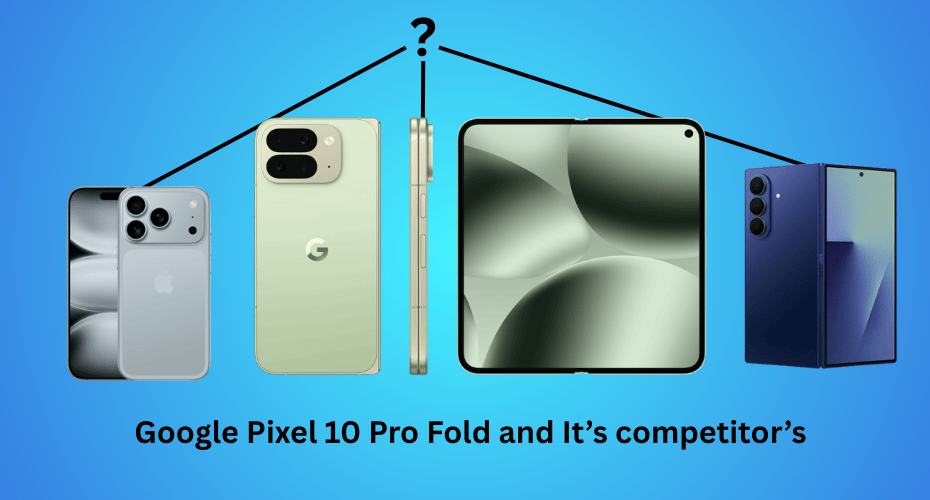
The Samsung Galaxy Z Fold 7 and Apple iPhone 17 Pro Max will be key competitors to the Google Pixel 10 Series. Check out the quick comparison table below to see how they stack up.
| Feature | Pixel 10 Pro Fold | Samsung Z Fold 7 | iPhone 17 Pro Max |
| Main Display | 8.0-inch OLED, 120Hz | 7.9-inch OLED, 120Hz | 6.9-inch OLED, 120Hz |
| Chipset | Tensor G5 | Snapdragon 8 Elite | Apple A19 Pro |
| Cameras | 48MP + 10.8MP + 10.5MP | 50MP + 12MP + 10MP | 48MP + 12MP + 12MP + LiDAR |
| Battery | 5015 mAh | 4800 mAh | 5000 mAh |
| Software | Android 16 (7 years updates) | Android 15 (4 years updates) | iOS 19 (7 years updates) |
| Price | $1,799 | $1,899 | ~$1,299 |
Google Pixel 10 Series – FAQs
Which Pixel 10 model is best for most people?
The Google Pixel 10 Pro offers the best balance of price, performance, and camera versatility.
Is the Pixel 10 Pro Fold worth it?
If you want cutting-edge foldable tech with great cameras and Google’s AI magic, yes. Otherwise, the Pro models are more practical.
How long will the Pixel 10 get updates?
Google promises 7 years of Android updates – until 2032 on Google Pixel 10 Series.
Does the Pixel 10 support faster charging than last year?
No, charging remains at 30W wired, 15W wireless.
Final Thoughts – Should You Buy the Pixel 10 Series?
The Google Pixel 10 lineup is easily Google’s strongest smartphone release ever. With refined designs, brighter displays, smarter AI features, reliable battery life, and long software support, the Pixel 10 series gives serious competition to both Samsung and Apple.
- The Pixel 10 is a great choice for those who want a clean Android experience at under $800.
- The Pixel 10 Pro is the sweet spot for most buyers.
- The Pixel 10 Pro XL caters to big-screen lovers.
- The Pixel 10 Pro Fold is the boldest Pixel yet – not for everyone, but a huge leap for foldables.
If you’ve been waiting for a Pixel that combines cutting-edge hardware with long-term value, the Pixel 10 series is the one to watch.